
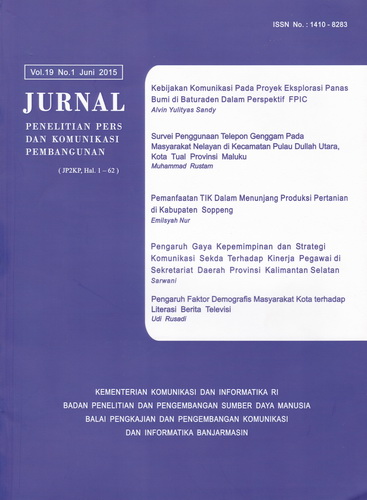
Pengaruh Faktor Demografis Masyarakat Kota Terhadap Literasi Berita Televisi
Abstract
The influence of media in communication studies and media practices has always became interest because in normative theories media is expected to provide functional effects. One of the assumption to make media has functional influence is the literacy condition of the society. Television news as the product of media has unique characteristic and process which vary from other non-media products, so certain literacy is needed by the society concerning to TV news. This study aims to explain the literacy condition of the urban society and the influence of demographic factors towards television news literacy. The study was conducted in Banjarmasin south Kalimantan using survey method. The result shows that people have always strong literacy to select in term of content, process, and assessment of the television news. The literacy perspective is still in positivistic context which regard news as the delivery process of reality and not as a construction of reality. Not all demographic aspects influence all aspect of literacy and aspect kinds of work have the most influence on the elements of news literacy.
Keywords: Literacy, Television News, Urban Society, Demographic.
ABSTRAK
Pengaruh media dalam kajian komunikasi dan praktek media selalu menjadi perhatian karena dalam teori-teori normatif, diharapkan mampu memberikan efek yang fungsional. Salah satu asumsi agar media berpengaruh fungsional, ialah kondisi literasi masyarakatnya yang harus memadai. Berita TV sebagai salah satu produk media memiliki karakteristik dan proses yang unik yang bebeda dengan produk lain yang bukan media, sehingga diperlukan literasi tertentu masyarakatnya terhadap berita TV. Studi ini bertujuan menjelaskan kondisi literasi masyarakat kota dan pengaruh faktor demografis terhadap literasi berita televisi. Penelitian dilakukan di wilayah kota Banjarmasin Kalimantan Selatan, dengan metode Survey. Hasilnya menunjukkan, masyarakat sudah memiliki literasi yang cukup kuat terhadap perlunya melakukan seleksi baik dalam aspek isi, proses dan penilaian berita televisi. Perspektif literasi mereka masih dalam konteks positivistik, yang melihat proses berita sebagai proses pengiriman realitas dan bukan konstruksi realitas. Tidak semua aspek demografis mempengaruhi semua aspek literasi dan aspek jenis pekerjaan memiliki pengaruh pada elemen literasi berita yang paling banyak.
Kata Kunci : Literasi, Berita Televisi, Masyarakat Kota, Demografis.
Downloads
References
Agung, I. G. N., 2003. Manajemen Penulisan Skripsi, Tesis dan Disertasi. Kiat-kiat untuk mempersingkat waktu penulisan karya ilmiah yang bermutu. Jakarta: UI Press
Arif, M. C., 2013. Tingkat Literasi Media Berbasis Kompetensi Individual Mahasiswa Fakultas Dakwah dan Ilmu Komunikasi IAIN Sunan Ampel Surabaya. IAIN Sunan Ampel Surabaya.
Ashley, S., Poepsel, M., Willis, E., (2010). Media Literacy and News Credibelity: Does Knowledge of media ownership increase skepticism in news consumers?. Journal of Media Literacy Education 2:1 (2010) 37- 46. The National Association for Media Literacy Education’s
Ball-Rokeach, S. J., & Melvin L. D., 1982, Theories of Mass Communication, New York: Logman
Buckingham, D., 2005. The Media Literacy of Children and Young People. A review of the research literature on behalf of Ofcom. London: Ofcom. Stakeholders.ofcom.org.uk.
Guba, E. G., & Denzin, L., Yvonna S., (2005). Paradigmatic Controversies, and Emerging Confluences dalam Norman K dan Yvonna S. Lincoln (ed). 2005. Handbook of Qualitatif Research. London, New Delhi : Sage Publication.
Harris, R. J., (2004). A Cognitive Psychology of Mass Communicatioan. Fourth edition, London: Lawrence Erlbaum Associates Publishers
Juditha, C., 2013. Literasi Media pada anak di Daerah Perbatasan Indonesia dan Timor Leste. IPKTEK-KOM Jurnal Komunikasi, Informatika dan Kebijakan, Volume 15 No. 1 Juni 2013. h.47-62. Yogyakarta: Balai Pengkajian dan Pengembangan Komunikasi dan Informatika.
Kirsch, I. S., Jungeblut, A., & Koistad, A., 1993. Adult Literacy in America. Afirst look at the Reults of the National survey. Washington: Educationbal Testing Service.
Klapper, J., 1960. The effect of Mass Communication, Glencoe, FreePress
Lewis, J., and Jhally, S., (1998). The Struggle over Media Literacy. Jurnal of Communication; Winter 1998; 48, 1; ABI/INFORM Global, pg 109. Internal Communiacations Association.
Lubis, E. E., & Rumyeni, 2013. Analisis Tingkat Literasi Media Mahasiswa di Jurusan Ilmu Komunikasi Universitas Riau. Seminar Nasional “ Poltik Birokrasi dan Perubahan Sosial dalam Upaya Membangun Karakter Bangsa.Pekanbaru” : FISIF Riau.
Masitoh, 2013. Melek Media khalayak pada tayangan talkshow di TV: Studi kasus pada tayangan talkshow Indonesia Lawyer’s Clubs di TV One (tesis) Program Pascasarjana Ilmu Komunikasi Konsentreasi Jurnalistik. Jakarta: IISIP Jakarta.
McManus, J. H., 1994. Market Driven Jurnalism. Let The Citizen Beware? London: Sage Publications
Potter, W. J., 2008. Media Literacy 4 th edition, Los Angeles, London, New York: Sage Publications.
Severin, W. J., & James. W. T. Jr., 1992. Communication Theories: Orgin, Method, and Uses in Mass Media, Lincoln. New York: Logman Pub Group.
Silverblatt, A., et all, 2014. Media Literacy Key to Interpreting Media Messages. Fourth Edition. California: Praeger.
Steyer, J. I., 2002 The other Parent: the inside story of media’s effect on our children, New York: Atria Books
Wright, C. R., 1975. Sosiologi Komunikasi, terjemahan Liweli Trimo & Jalaluddin Rahmat, Bandung: Rosda Karya.
For Bahasa Indonesia can be read here: Mengakui Pernyataan Hak Cipta
Authors who publish with this journal agree to the following terms:
Copyright on any article is retained by the Journal
- Author grant the journal right of first publication with the work simultaneously licensed under a Creative Commons Attribution License that allows others to share the work with an acknowledgement of the work's authorship and initial publication in this;
- Authors are able to enter into separate, additional contractual arrangements for the non-exclusive distribution of the journal's published version of the work (e.g., post it to an institutional repository or publish it in a book), with an acknowledgement of its initial publication in this journal;
- Authors are permitted and encouraged to post their work online (e.g., in institutional repositories or on their website) prior to and during the submission process, as it can lead to productive exchanges, as well as earlier and greater citation of published work;
- Every accepted manuscript should be accompanied by Copyright Transfer Agreement (CTA), prior to the article publication. CTA can be downloaded here;